 A power bank charging a mobile phone.
 An AvSax lithium battery fire mitigation bag
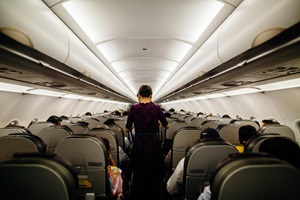 The last place you'd want a toxic lithium battery fire is at 30,000ft in the confined space of an aircraft passenger cabin
 All these portable electronic devices are powered by lithium batteries
Airlines are clamping down on lithium batteries on board aircraft after one plane was totally destroyed by a blaze thought to be caused by a power bank charger.
The Air Busan passenger aircraft was wrecked on the runway in South Korea after a power bank is believed to have caught fire in an overhead luggage bin and the flames then swept through the entire plane as passengers were quickly evacuated.
Months later another power bank in an overhead bin caught fire on an Air China plane in full flight but fortunately the crew managed to bring it under control as the plane made an emergency landing.
These are just two among many fire-related incidents on aircraft worldwide sparked by overheating or burning lithium batteries which power all our everyday electronic devices.
During many mid-air fires, cabin crews deployed specialist lithium battery fire containment bags such as AvSax which has been the best-selling brand and is now on almost 17,000 aircraft worldwide.
Passengers use portable power banks to charge the lithium batteries in their phones, tablets, laptops and many other electronic devices on the go.
But they come with extra risk. Unlike smartphones or laptops, a power bank contains only a battery with no active thermal management, no temperature sensors and no software monitoring for unusual power draw. When something goes wrong there is no safety backup to catch it before it escalates.
This has led to the tough new rules with many airlines now insisting power banks must always be in the passenger cabin so the crew can deal with them quickly if they overheat or catch fire.
They must also not be put in the overhead luggage bins or used to charge electronic devices while on aircraft operated by many airline companies.
Lithium battery safety – including a warning to inform cabin crew immediately if your electronic devices overheats – is now part of the standard pre-flight safety briefing to passengers just before the plane takes off.
The Federal Aviation Administration which regulates American airline operators and USA airspace is the only governing organisation worldwide which reveals figures about lithium battery incidents on this chart.
There have been 561 verified incidents since March 2006 with 228 caused by battery charges and 113 sparked by vapes and e-cigarettes which can catch fire even though smoking is banned on board. Mobile phones accounted for 81 of the incidents with other electronic devices responsible for another 72 and laptops 65.
These figures are just in the USA which suggests hundreds more incidents will have happened elsewhere in the world but gone unreported to the public. No other regulatory authority releases lithium battery incident figures, including the Civil Aviation Authority in the UK.
When lithium batteries overheat they go into a chemical process called thermal runaway and when this happens it can produce enough heat – up to 900°C (1652°F) – to cause adjacent cells to overheat.
This can cause a lithium battery fire to flare repeatedly and they are then very difficult to put out. They can even explode.
Thousands of aircraft worldwide now carry AvSax lithium battery fire containment bags which won the Queen’s Award for Enterprise in the UK for their innovation – the highest award any business can get.
AvSax special projects director Jessica Bailey said: “It will come as quite a shock to people to learn that battery chargers and vapes are responsible for so many fires on planes but we only have figures for one part of the world so it’s unclear just how many more are happening on a weekly or monthly basis worldwide.
“We know they are happening in the UK as airport firefighters have told us they are dealing with more and more lithium battery incidents.’’
Jessica added that it can be very frightening to be on board an aircraft at 35,000ft when a lithium battery sparks a fire.
“It means that when an incident happens the passenger cabin can quickly fill with toxic smoke and the crew often needs to divert and do an emergency landing,’’ she said. “This is costly to the airline company and very disruptive for the passengers, not to mention the safety implications.
“Aircraft equipped with lithium battery containment bags such as AvSax usually carry on to their destination knowing the overheating device is safely contained.”
AvSax, devised by British company Environmental Defence Systems Ltd, are now on board around 16,750 aircraft operated by more than 100 airline companies worldwide, including some of the best-known names in the aviation industry.
AvSax have been deployed in action dozens of times on board aircraft since 2017 and on every occasion the aircraft was able to continue safely to its destination with no need to divert or make an emergency landing.
To make flying as safe as possible vapes, e-cigarettes and all personal electronic devices should be kept in the cabin, not in checked luggage in the aircraft hold, so if there is a problem with the battery the crew can deal with it.
For more on AvSax go to www.avsax.com


